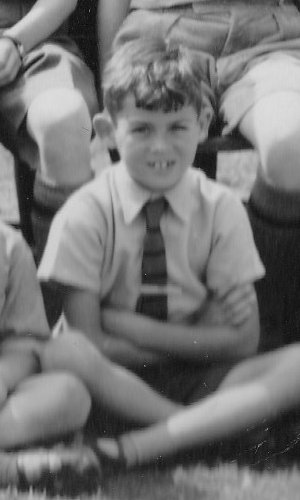
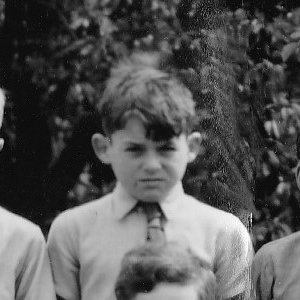
Nicky Klein
at Cumnor House School,
South Croydon, Surrey
left: June 1960, age 7
above: June 1962, age 9
|
|
Nicky Klein at Cumnor House School, South Croydon, Surrey left: June 1960, age 7 above: June 1962, age 9 |
Nicholas Klein, known as Nicky, was born in Warwick Road, Redhill, Surrey, possibly in Hunton House, on 4th January 1953. He attended Cumnor House School in South Croydon, Surrey from 1959 to 1966, and Mill Hill School in north London from 1966 to 1968. He would have taken his O Level exams in about 1969 and his A Level exams in about 1971. He subsequently worked as an engineer.
Nicky's mother, Patricia Mary Klein, formerly Steel, née Kelly, was born in Paddington, London on 22nd February 1920. Her father was Maurice Henry Kelly, whose profession in 1948 was executive officer (Ministry of Supply), and her mother was Katherine (Kitty) Henriette Mary Kelly late Redfern née Witting.1 In 1942 Maurice and Kitty's address was Ash Manor, Ash Green, Surrey.2
Patricia served in the Women's Auxiliary Air Force during the Second World War.2 Her first marriage was to Major Peter Crawford Steel in Bournemouth in the third quarter of 1942. Their daughter Lindsay Mary Steel was born at 3 Wilbraham Place, Chelsea on 20th May 1943. On Lindsay's birth certificate, Peter and Patricia's address was Hoo' Gate, Woodbridge, Suffolk, which was Peter's parents' address.2
Peter Crawford Steel was born in Chile in about 1914, the son of Walter Crawford Steel (1884-1962) and Margarita Steel née Backus (c1889-c1963). Margarita Steel née Backus was the daughter of Jacob Backus II (1843-1899)3, an American who co-founded, with another American, John Howard Johnston, the Backus and Johnston brewery in Lima, Peru in 1879.4 Peter Crawford Steel was a career soldier, passing out from the Royal Military College at Sandhurst as a Second Lieutenant in The King's Shropshire Light Infantry on 30th August 1934.5 6
The 6th June 1944 was D-Day, the first day of the allied offensive in north-west Europe, which began with the Normandy landings. Soldiers of the 2nd Battalion of the King's Shropshire Light Infantry landed on Sword beach near Hermanville shortly after 10 a.m. and were to advance inland on the back of Sherman tanks of the Staffordshire Yeomanry. But with the congestion on the invasion beaches, the tanks did not arrive.7
So the Shropshires walked, following the D60 road. At 5.30 p.m. Major Steel's Company had reached Lebisey, north of Caen. However they had advanced so far that they were out on a limb, and had to withdraw. Major Steel was killed by a machine gun bullet at Lebisey on D-Day, the 6th June 1944,7 and was buried in Ranville War Cemetery.8
Nicky Klein's father was Eduard Klein, who was born in Holland on 27th August 1910. Did he serve in the Second World War and, if so, in what way? His profession in 1948 was company director (radio), in 1953 export merchant, and in 1972 and 1982 company director. Eduard Klein's father was Jacob Klein, whose profession in 1948 was company director.
Nicky's parents, Eduard and Patricia, married in north-west Surrey on 1st September 1948. Their address in 1948 was 11 Langdale Close, Horsell, Woking, Surrey, and in 1953 8 Ivy Mill Lane, Godstone, Surrey, which was also Eduard's place of work.
I was at Cumnor House School with Nicky from 1959 to 1963. We were best friends. Because his half-sister was ten years older, I went on holiday with him and his parents to the Isle of Wight, in their Morris Minor convertible (with the hood down). (When I bought my first car in 1971, for £85, it was also a Morris Minor convertible, but a different colour.) Nicky and his family lived in Coulsdon Court Road, Coulsdon, Surrey. In those days most people had a black and white television, but they chose not to have one. Nicky was planning to stay about three more years at Cumnor House School, taking the Common Entrance exam there, and then to go to Mill Hill School, which he did.
Nicky did not like the school lunches at Cumnor House. They were not appetising but they had to be eaten. If they were not eaten fairly quickly, they would become cold and congealed, and even less appetising. The plate would not be taken away until the food had been eaten. Nicky would sit there, crying his eyes out, with the plate of food in front of him becoming colder and more congealed. It seemed to be cruel, but there was nothing I could do about it.
During Nicky's and my friendship at Cumnor House School, Nicky started bullying me. It seemed incongruous for someone to bully his best friend. It was the reason I asked my parents if I could sit the entrance exam for the junior school of my next school, instead of waiting to take the Common Entrance exam at the prep school. Nicky was quite upset when I left the prep school. I didn't tell him I had decided to leave early because he had been bullying me. We didn't see each other again, or even contact each other. I wish we had.
In 1965 Nicky's half-sister gave birth to a daughter who was given up for adoption. She subsequently married twice, and gave birth to one daughter by her first marriage and to two daughters, in 1974 and 1979, by her second marriage.
Nicky left Mill Hill School in 1968. Did he go to another school after Mill Hill, and where did he attend higher education? Which branch of engineering did he study and work in? Who did he work for? Did he marry or have any children?
Nicky's mother, Patricia, died in Freedom Fields Hospital, Plymouth, Devon on Friday 21st January 1972, when she was 51 years old and Nicky was 19. On that day she had been a passenger in a car which collided with a lorry travelling in the opposite direction in Hillcrest Drive, Plympton, Devon. Patricia and Eduard's address was Sunnyside Guest House, Ivybridge, South Devon. Nicky's father, Eduard Klein, died from cancer of the bronchus on his 72nd birthday, 27th August 1982, at the Royal Devon and Exeter Hospital, Exeter. Nicky was 29.
Nicky was last seen alive on Friday 13th January 1984, when he was 31 years old. He was found dead four months later, on Sunday 20th May 1984, in Savernake Forest, near Marlborough, Wiltshire. His address had been 1 Woodcott, Thornbury, Holsworth, North Devon. An inquest on 29th August 1984 into his death recorded the cause of death as not known.
Nicky's niece, who had been given up for adoption, found her mother and her three half-sisters in 2019.
I thought of Nicky's half-sister and her daughter, who was born in 1965 and given up for adoption, when I read the obituary of the actress Pauline Collins (1940-2025), which was published in The Times. This is an excerpt from it:
She is survived by her husband, whom she married in 1969; their children Nicholas, Kate and Richard; and by an older daughter, Louise, whom she gave up for adoption in 1964. When she discovered that she was pregnant she had already split up with the child's father, the actor Tony Rohr, and felt unable to cope as a single mother.
When Louise was 21, she tracked down her mother and they were reunited. It led in 1992 to Collins publishing a book, Letter to Louise, a moving account of her own childhood and early adulthood leading up to the adoption.
"I remember the last time I saw you," she wrote of the moment when she handed over her daughter. "Every day of my life I've relived that moment, replayed each second like a book of flicker pictures, clinging frame by frame to the last images of you. Now I cannot understand why I did that terrible thing, why I didn't look harder for another solution."
Second Supplement to The London Gazette of Friday, the 3rd of October, 1919.
War Office, 4th October, 1919.
With reference to the Awards conferred as announced in the London Gazette, dated 8th March, 1919, the following are the statements of services for which the decorations were conferred:—
Awarded the Military Cross.
Lt. (A./Capt.) Walter Crawford Steel, R.F.A., Spec. Res., attd. A/153rd Bde.
[Lieutenant (Acting Captain) Walter Crawford Steel, Royal Field Auxiliary, Special Reserve, attached to A Battery, 153rd Brigade.]
For conspicuous gallantry and good work. On 14th October, 1918, he pushed forward into Moorseele and captured four prisoners. He got his guns up at once, and having established communication with battle headquarters, brought fire to bear on several points where infantry reported machine guns to be located. On 15th, he again pushed forward, and under heavy fire, shot with a captured 4.2 in. gun with open sights at the enemy at 700 yards range.
Notes